
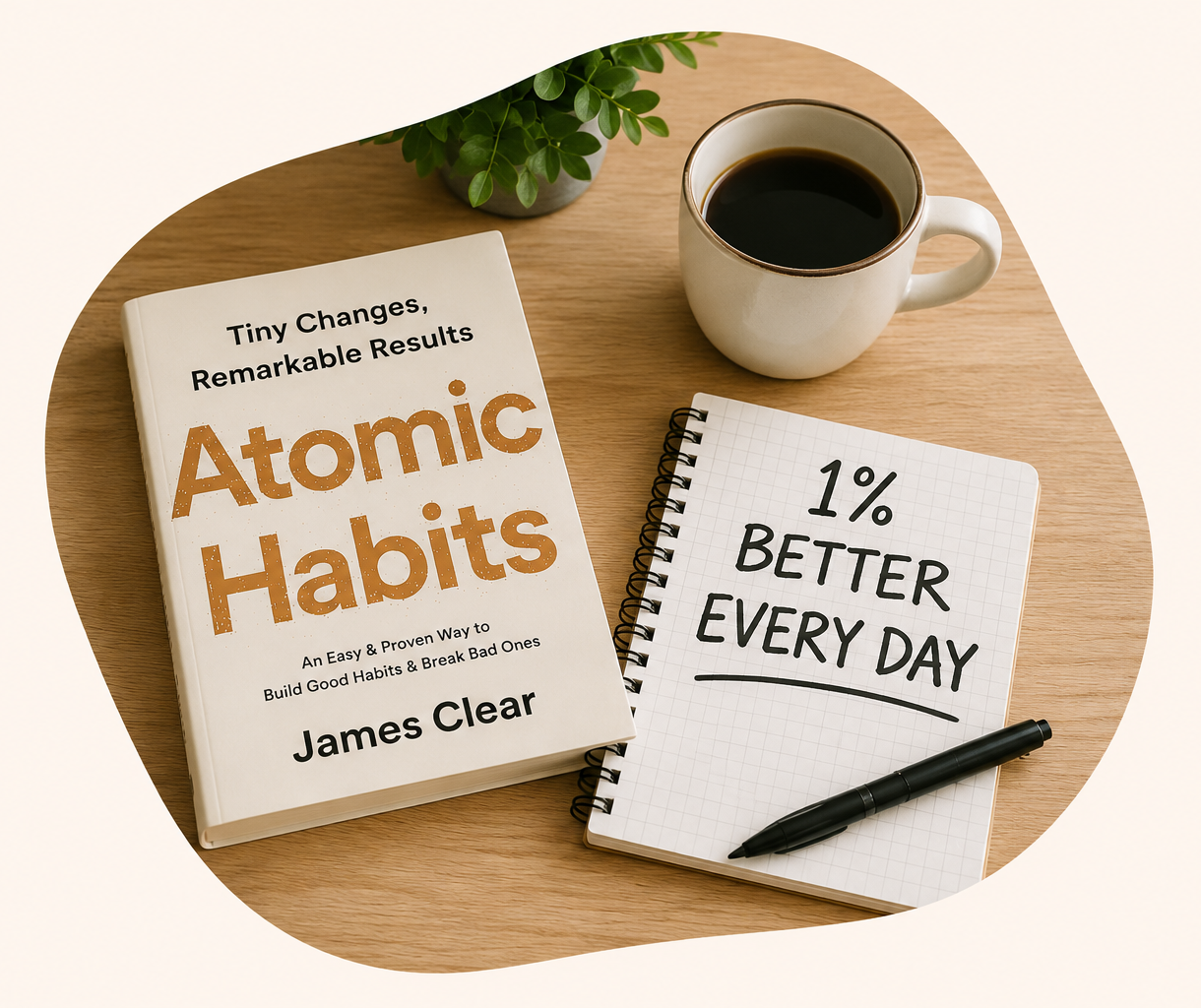
“You do not rise to the level of your goals. You fall to the level of your systems.” — James Clear
Have you ever wondered why some people completely transform their lives within a few years while others remain exactly where they started?
Both have the same 24 hours.
Both have dreams.
Both work hard.
So what creates the difference?
It isn’t talent.
It isn’t luck.
It isn’t even intelligence.
The real difference lies in the tiny decisions people make every single day—the decisions so small that most of us don’t even notice them.
That is exactly what Atomic Habits by James Clear teaches us.
This is not another book that promises overnight success or instant wealth. Instead, it explains something far more powerful:
Small habits, repeated consistently, can completely transform your life.
Let’s explore the most powerful lessons from one of the world’s bestselling self-improvement books.
The Story Behind Atomic Habits
Before understanding the book, it’s worth knowing the story of the man who wrote it.
James Clear wasn’t born as a bestselling author or productivity expert.
During high school, while playing baseball, he suffered a devastating accident. A fast-moving baseball bat struck his face, breaking multiple bones and causing severe injuries. For a period of time, even his memory and daily functioning were affected.
Most people would have accepted defeat.
James chose something different.
He didn’t try to change his life overnight.
He didn’t chase impossible goals.
Instead, he made one simple promise to himself:
Become just 1% better every day.
One small improvement.
One better decision.
One tiny habit.
That simple philosophy eventually became the foundation of Atomic Habits.
Why Tiny Improvements Matter More Than Big Change
Imagine improving yourself by only 1% every day.
It sounds insignificant.
In fact, after one day you probably wouldn’t notice any difference.
Even after one week…
Nothing dramatic.
Even after one month…
Life might still look the same.
That’s exactly why most people quit.
They assume nothing is changing.
But success doesn’t appear suddenly.
It builds silently.
Every tiny improvement compounds until one day people look at your life and call you an “overnight success.”
They only see the destination.
They never see the thousands of invisible steps that got you there.
The Ice Cube Lesson: Why Progress Feels Invisible

Imagine placing a block of ice in a room that’s -5°C.
The temperature rises to -4°C.
Nothing happens.
Then -3°C.
Still nothing.
-2°C… -1°C…
No visible change.
At this point, you might think increasing the temperature is pointless.
Then the room reaches 0°C.
Suddenly…
The ice begins to melt.
Did the final one degree create the change?
No.
Every previous degree mattered.
The last degree simply revealed the progress that had been building all along.
Our lives work exactly the same way.
We often work hard for weeks or months without seeing visible results.
We begin to doubt ourselves.
We assume our efforts are wasted.
But beneath the surface, change is already happening.
The breakthrough is simply waiting for the right moment.
Why Most People Give Up Too Early
How often have you said things like
- “I’ve been going to the gym, but my body hasn’t changed.”
- “I’ve been studying, but I’m not improving.”
- “I started a business, but customers aren’t coming.”
The problem usually isn’t effort.
The problem is expectation.
We plant the seed today…
And expect the fruit tomorrow.
Nature doesn’t work that way.
Before a seed becomes a tree, it spends weeks growing roots beneath the soil.
No one sees the process.
Everyone notices the tree.
Success follows the same pattern.
The invisible work always comes before visible rewards.
The Real Power of Small Habits
Most people believe that achieving big dreams requires taking massive actions.
James Clear argues the opposite.
Your future isn’t determined by one life-changing decision.
It’s shaped by hundreds of ordinary decisions repeated every day.
If your dream is to become a writer…
Writing 300 words every day is far more valuable than writing 3,000 words once a month.
If your goal is better health…
Walking 20 minutes daily is more effective than spending five exhausting hours in the gym once a month.
Great success isn’t built through dramatic moments.
It’s built through ordinary routines.
Tiny actions become habits.
Habits become identity.
Identity shapes destiny.
Stop Chasing Results. Build Better Systems.
One of the biggest messages in Atomic Habits is that successful people don’t obsess over goals.
They focus on systems.
Goals tell you where you want to go.
Systems determine whether you’ll actually get there.
Winning once doesn’t change your life.
Changing your daily routine does.
That’s why sustainable success isn’t about motivation.
It’s about creating habits that continue even when motivation disappears.
Change Your Identity Before You Change Your Life
| Goal-Based Thinking | Identity-Based Thinking |
|---|---|
| “I want to lose weight.” | “I am becoming a healthy person.” |
| “I want to learn English.” | “I am an English learner who practices every day.” |
| “I want to become successful.” | “I am someone who improves myself every single day.” |
| Focuses on what you want to achieve. | Focuses on who you want to become. |
| Motivation fades over time. | Identity drives consistent actions. |
| Temporary results. | Lasting transformation. |
A Simple Example That Changes Everything
Imagine two people are offered a cigarette.
The first person replies,
“No thanks… I’m trying to quit smoking.”
The second person says,
“No thanks… I don’t smoke.”
Both refuse.
But mentally, they’re completely different.
The first person still believes they’re a smoker who’s resisting temptation.
The second person has already changed their identity.
And once identity changes…
Decisions begin to change automatically
The Four Laws of Building Good Habits
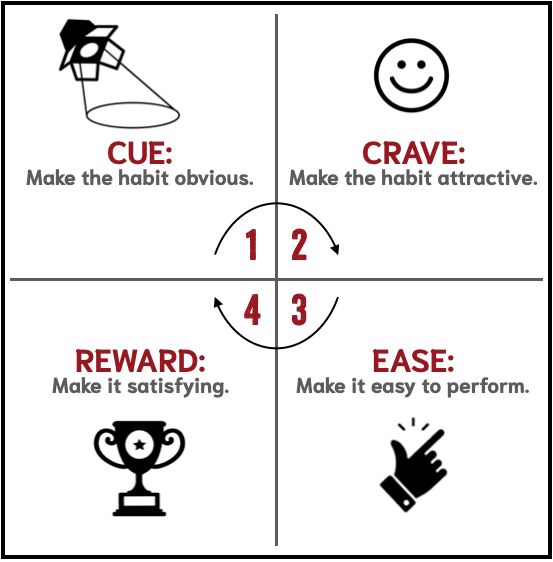
Understanding these four laws can help you build good habits—and break bad ones.
1. Make It Obvious
Your environment shapes your behavior.
If you want to read more…
Don’t hide your book inside a drawer.
Keep it on your desk.
Place it beside your bed.
Make your desired habit impossible to ignore.
The more visible the cue…
The stronger the habit becomes.
2. Make It Attractive
Our brains naturally move toward pleasure.
If a habit feels boring, consistency becomes difficult.
Want to walk every evening?
Listen to your favorite podcast.
Want to study?
Create a comfortable study space or reward yourself afterward.
James Clear calls this “temptation bundling.”
Pair something you need to do with something you enjoy.
Your brain gradually starts looking forward to the habit instead of avoiding it.
3. Make It Easy
This may be the most practical lesson in the book.
People often wait for motivation before taking action.
Successful people do the opposite.
They make action so easy that excuses disappear.
Can’t study for 30 minutes?
Study for two.
Can’t complete a full workout?
Wear your running shoes and step outside.
Can’t write an article?
Open your laptop and write one sentence.
Starting is always the hardest part.
Once you begin…
Momentum takes over
4. Make It Satisfying
The human brain repeats behaviors that feel rewarding.
Celebrate small wins.
Finished today’s reading?
Mark an “X” on your calendar.
Completed your workout?
Take a moment to acknowledge your progress.
These tiny rewards tell your brain,
“This is worth repeating.”
Over time…
The habit becomes part of who you are.
Why Breaking Bad Habits Feels So Difficult
Have you ever decided to use your phone less?
You wake up motivated.
Then a notification appears.
You unlock your phone “for just one minute.”
Before you realize it…
You’ve spent an hour scrolling through short videos.
Was it really your decision?
Or did your environment make the decision for you?
This is why willpower often fails.
Environment is usually stronger than motivation.
Design Your Environment for Success

If your phone is always on your study table…
Guess what your brain will choose?
If junk food is easier to reach than fruit…
Guess what you’ll eat?
Your surroundings constantly influence your choices.
So instead of fighting temptation…
Reduce it.
- Keep books where you can see them.
- Prepare your workout clothes the night before.
- Remove distracting apps from your home screen.
- Turn off unnecessary notifications.
- Keep your phone away while working.
Make good habits easier.
Make bad habits harder.
That’s one of the simplest formulas for long-term success.
The Farmer Who Trusted the Process

Imagine a farmer watering his field every single day.
For weeks…
Nothing changes.
The soil looks exactly the same.
There’s no sign of growth.
If he stopped watering because he couldn’t see results…
The seed would never become a tree.
But he trusted the process.
Day after day.
Eventually, a tiny plant appeared.
Years later…
That same plant became a tree filled with fruit.
Your efforts work exactly the same way.
Progress is often invisible before it becomes undeniable.
The Three Biggest Lessons from Atomic Habits
If the entire book had to be summarized in just three ideas, they would be these:
1. Become 1% Better Every Day
Small improvements may seem insignificant today.
But over months and years, they create extraordinary results.
2. Focus on Identity, Not Goals
Don’t simply chase success.
Become the kind of person who naturally succeeds.
3. Make Good Habits So Easy That Skipping Them Feels Hard
The easier your habits are to start, the more likely you are to continue them.
Success is rarely about intensity.
It’s almost always about consistency.
Small messages for you 💛
Your daily habits are the greatest investment you will ever make.
The tiny decisions you make today quietly shape the person you’ll become five years from now.
Don’t wait for Monday.
Don’t wait for New Year’s resolutions.
Don’t wait for the “perfect time.”
Start today.
Start small.
Because small habits don’t just improve your day…
They reshape your future.
Perhaps that’s why James Clear chose the title Atomic Habits.
Just as countless tiny atoms come together to build the world around us…
Tiny habits come together to build the life you eventually live…
[…] habits create a strong […]
[…] habits create a strong […]
[…] When your decisions change… Your habits change. […]